Experience and Heuristic method

Experience gives us a better chance at guessing solutions to a problem.

For instance a 220 Ohm resistor is a good rule of thumb for an LED current Limiting resistor in a 5 volt circuit.  A simple guess for a 10 volt circuit would be to just double the resistance to around 440 ohms.  Unfortunately this will probably burn out the LED.  From experience of doing the calculations, you would recognize that a 1000 ohm resistor usually works well in a 10 volt circuit.

Heuristic method comes in to play when you are working in an area that you are less experienced in.  You look at how similar operating circuits have worked in the past and make an educated guess to design the new circuit. Sometimes you just make a guess and then test, even with no reasoning as why that guess would work.

So if you are a tinkerer or an engineering student, go get some experience. Go build some circuits, make some changes, break something, then try to fix it or maybe improve it.
Happy π Day

Today, Saturday March 14th 2015 is Pi day.  The first 5 digits of Pi(3.1415) can be used to represent today’s date. Pi is the ratio of the circumference of a circle to it’s diameter.  Although Pi is defined in reference to a circle, Its value is used in many branches of mathematics.

As an engineer or tinkerer, mathematics is important. Don’t let that scare you if you aren’t good at math.  We are in a unique position in history. The internet has made lots of information available at your fingertips.  This means that as long as your not on the cutting edge of design, you can usually find the information you need without having to do the calculations yourself.

As a professional engineer, you are more valuable to your employer(even if you are self employed) if you understand the key math to your project.  If you don’t know some of the principle math for a project, you can use reference designs for the section you don’t understand. You can use modelling software to modify your design before prototyping. You can go to online courses like Khan Academy that will help you understand the concepts. If you are a tinkerer or an engineer, I highly recommend you practice using your preferred search engine – Keep refining your search when you don’t find what you are looking for.

The universal programmer design that needs basic understanding of the math necessary to work out Ohms Law and simple logic. The complex math necessary for understanding the processor, or how a charge pump works has been all worked out for us and is hidden from the design.

Processor Option 2

The Microchip PIC32MX110F016B.

I went to Microchip’s website and worked through their parametric search tools.  I was looking for a device that could use the SPI interface at at least 10 Mbps and at the lowest cost.  There were no 8 bit parts that could meet the SPI requirement.  There were some 16 bit parts that could meet this requirement, but they were the high end parts.  I had to look into the datasheets to see the maximum SPI baud rate.  Since JTAG does not have 8 bit fixed width registers, I will probably have to play some tricks to use the standard SPI for JTAG operation.


Microchip PIC32MX110F016B

Device advantages

  • Two Fast SPI channels (1 for programming, 1 for data storage)
  • DMA transfers for each SPI channel– Frees software up to do data manipulation tasks
  • 5 V tolerant pins
  • I am familiar with Microchip and their IDE — MPLAB X
  • US $1.73 each in quantities of 100
  • Compatible upgrade path if this chip isn’t enough
  • Low pin count — 28 pins
  • Dip Part for prototyping

Device Disadvantages

  • I am unfamiliar with microchip 32 bit architecture
  • Limitations on free C compiler — mostly in optimization


Radio Option 3

The HC05 Bluetooth Module is another possible candidate for the radio system.

It has a potential of 1.3Mb/s transfer rate.  It is priced at US$5 in singles.  It uses bluetooth serial port profile. It doesn’t appear to have FCC certification. It would come programmed from manufacturer.


Advantages to the design:

  • Easy to use
  • Low Cost
  • good speed

Disadvantages to the design:

  • Lack of FCC certification could force a redesign.

The FCC problem is too big, this radio is removed from the possibilities.

Block Diagram

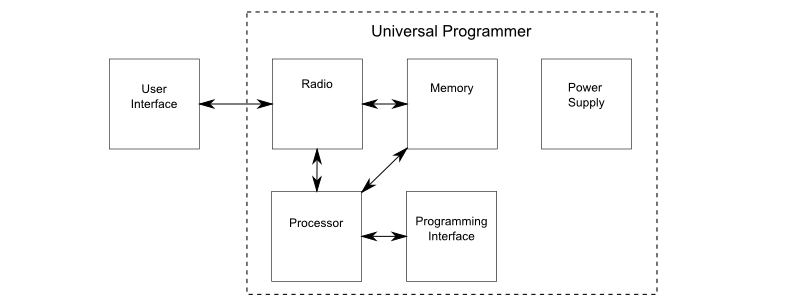
One good way of organizing a design is a block diagram.  It is like a macro view of the design.   It helps you to see the relationships between the functional parts of the design.

In this project I see six major functional blocks.

These functions are the The User Interface, radio connection, processor, memory, Power supply, and programming Interface.


Programmer Block

Radio Option 2

ESP8266 ESP12 wifi module.  This module is very inexpensive (US $3.45 in small quantities) and has FCC certification markings on RF shield.

Wifi has the potential for much higher data speeds than bluetooth.  Documentation for this module is very scarce.  I do not know how difficult it would be to implement into the design.  There does seem to be a large group of enthusiasts that are playing with it and posting about it.

On the Arduino forum there appears to be helpful information about using and programming this module.

www.esp8266.com appears to be a community created and supported forum and wiki dedicated to this family of wifi modules.

This module already has a large open support community which would be valuable for this project.


Bluetooth Radio Option 1

Murata LBCA2HNZYZ-711 BLE module w/antenna priced at US$ 5.57 in Quantities of 1,000.

This includes FCC certification.  This means for commercial sales, i don’t have to get the system certified.  Certification is a large cost for radios developed to go to market.

Bluetooth Low Energy (BLE) has an approximate max data throughput of 10.6 KB/s.  This is very constraining for large devices such as routers and smart phones.

For estimation I will calculate the time to upload to a 1 GB router.

1,000,000 KB = 1GB

1,000,000 /10.6 = number of seconds to upload

94,339 seconds to upload 1 GB

94339/3600 = 26 Hours to upload (Not very feasible for very large devices)

This might require a change on design specs, however very few devices need a 1GB upload.

Most Devices are under 1 MB. which would take approximately 95 Seconds.  This is not horrible when trying to rescue a brick but very frustrating for production work.

Bluetooth Low energy is not in every smart phone, but is becoming common.

This choice has some positives and Negatives.  It is not ruled out yet.

Cardboard Dummy

Occasionally in design we get stuck.  Maybe you hit a roadblock in the design, or your prototype is doing something strange and you can’t figure it out. It is often helpful to talk about it with someone else. This doesn’t necessarily need to be someone that knows your project or even electronics design principles.

A Cardboard Dummy is someone that you can talk to about your design.  They need to know about as much as a cardboard cutout figure. By describing your problem to someone that doesn’t know anything about your design, you are required to break down the design into simpler terms.  When you describe a problem to another person, you have to explain any assumptions you have made. Without this explanation they will not understand your design choices.

This process changes your perspective on your design. If you are looking too closely at details, You might not see a macro level interaction or vice versa. The more you have to explain your assumptions the more your perspective has to change.

Mistakes

Mistakes are a part of design. Often mistakes are our biggest learning opportunities. Research will only take you so far, sometimes you have to be the first one to try that crazy idea.

Mistakes cost money, time, pride, and good feelings to name a few. Every mistake we make is an opportunity to learn. Sometimes the lesson is to be more careful, other times it is a paradigm shift.

Careful planning and well designed experiments can help us reduce the number of mistakes we make.  As part of my job, when we finish a layout, we check the plot back against the schematic and part pin diagrams.  I have caught many errors and flaws in the design during this process.

Potential Processor

This week I saw an advertisement for a potential processor.   The Cypres PSoC 4 BLE line of processors

Advantages:

Built in BLE radio (Bluetooth LE connection to many modern cell phones)

Very powerful ARM core processor

highly configurable IO

Wide operating voltage range 1.7 – 5.5 V

$50 dev Kit (CY8CKIT-042-BLE)

very robust library of hardware features

Disadvantages:

No Built in antenna (requires FCC licensing for commercial products)

High Price tag for for chips around $4 each in quantities of 1K

no USB for firmware update

No Linux support for PSoC creator